
Why You Need and Automatic Leak Detection System for your Summer Home
Why Do I Need an Automatic Leak Detection System?
One recent study estimated that homeowners could eliminate up to $8.5 billion a year in property damage if they only deployed an automatic water leak detection and shut-off system to prevent or reduce damage from water. Water caused $9.1 billion in annual homeowner policy property losses from 2007 to 2009 – approximately 23 percent of all homeowner property losses during that period. But up to 93 percent of the cost of water damage could have been prevented or minimized if an automatic water leak detection and shut-off system had been present in the homes, according to an ACE Private Risk Services study of damage sustained by affluent homeowners. ACE Private Risk Services is the high net worth personal lines business of the ACE Group.
Last January one of our customers got the call you never want to receive – a neighbor said there was water pouring from her unoccupied, ocean block summer home. We believe the leak happened because a guest failed to firmly latch an exterior door leading to a storage closet on the roof deck. Extremely strong winds battered the door repeatedly, causing it to partially break off its hinges. Then several days of strong winds and extremely low temperatures caused a pipe leading to an exterior hose bib to burst. The water ran for hours before the alert neighbor called. It was the worst case scenario – the leak was on the roof of the top floor and water ran through all three floors of the house.
Fortunately, the customer at excellent homeowner’s insurance and we are working diligently to get the house ready for the upcoming summer season. We learned from the claims adjuster that her insurance company, AIG, has a program to subsidize the cost of leak detection systems. The adjuster put us in touch with a third-party company that they use to recommend the best system for each situation.
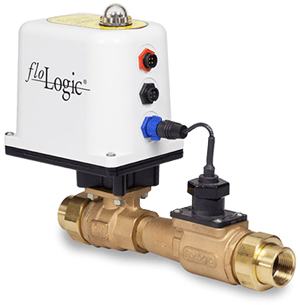
What we learned is that there are two major types of systems. The first type uses leak detectors placed strategically throughout the house. When one of these detectors senses water it will shut off the water main minimizing the amount of damage. The second type of system senses unusual duration and/or volume of water flow and also shuts off the water main when a leak is suspected. We spent a fair amount of time assessing the pros and cons of each system and decided on a flow-based system manufactured by FloLogic, Inc.
What sold us on this system is the fact that it automatically goes into shut off mode when there is no water flow for a period of 18 hours. Many of our customers’ homes are unoccupied during the winter months. This feature automatically shuts off the flow of water to the home when it is not in use for extended periods. There are also shorter-term timers that can be set as well as a manual override switch that the homeowner can use when exiting the property. But the 18-hour automatic shut off is the failsafe that protects the property when the owner (or their guests) forgets to use the manual override.
The loss in this particular case was well over $100,000. Had this leak occurred later in the winter it is likely that the customer would have been without the use of her home for part of the summer. We strongly recommend that all our second home customers consider installing a system similar to the FloLogic system. Feel free to give us a call at 302-227-8876 if you would like to discuss options to protect your home.